
But one is better than none.
Six minute listen – Listen to this article:
One oxygen concentrator gets you off bottles. That alone changes how a studio runs: no delivery schedules, no rental fees, no swapping cylinders mid-piece.
But most artists who start with one concentrator find out quickly where its ceiling is. The flame gets weak at the moments you need heat most, or the tank runs down and you stop to wait for it. A second concentrator doubles your oxygen supply. For most small and medium torches, that’s more than the torch will ever ask for at once, and it gets you close to running a large torch.
In practice, adding a second concentrator is often the difference between “I take breaks when I work” and “I work nonstop.”
Two numbers matter most to a working artist: how long you can work before the tank runs low, and how long you wait for it to refill. A second concentrator improves both. Refill time is cut in half, every time. Run time gets longer every time too, and often doubles or more. How much depends on the torch: on a Mirage at realistic settings you go from about 3 hours to never running out, while on a Red Max at full flame the gain is closer to 10 minutes.
How we ran the numbers
All torch flow rates below come from our Lampworking Torch Data page. A few ground rules:
- Concentrators run at about 80% of their rating. That’s where they hold their highest purity. A 10 LPM concentrator delivers about 8 LPM, and a 5 LPM concentrator delivers about 4 LPM.
- Full out vs. realistic. Torch ratings are maximum draw. Very few artists run their torch wide open all session. For a realistic figure we’ve used an average of 60% of maximum draw.
- Tank figures use a 60 gallon tank on a Stage 2, filled to 105 psi and run down to 20 psi. Below 20 psi a torch stops behaving the way it should. That window gives about 1,300 litres of usable oxygen.
Want to try your own setup? Plug your torch and system into our Oxygen Runtime Calculator.
Small torches: concentrators alone
With no tank, the concentrator has to keep up with the torch in real time. If it can’t, the flame suffers.
| Torch | Max draw | Realistic draw | One 5 LPM (4 LPM) | One 10 LPM (8 LPM) | Two 10 LPM (16 LPM) |
|---|---|---|---|---|---|
| GTT Cricket | 5.5 LPM | 3.3 LPM | Realistic only | Yes | Yes, with lots of room |
| Nortel Minor | 7 LPM | 4.2 LPM | Falls short | Yes | Yes, with lots of room |
| GTT Bobcat | 8.5 LPM | 5.1 LPM | Falls short | Realistic only, short at full flame | Yes, with lots of room |
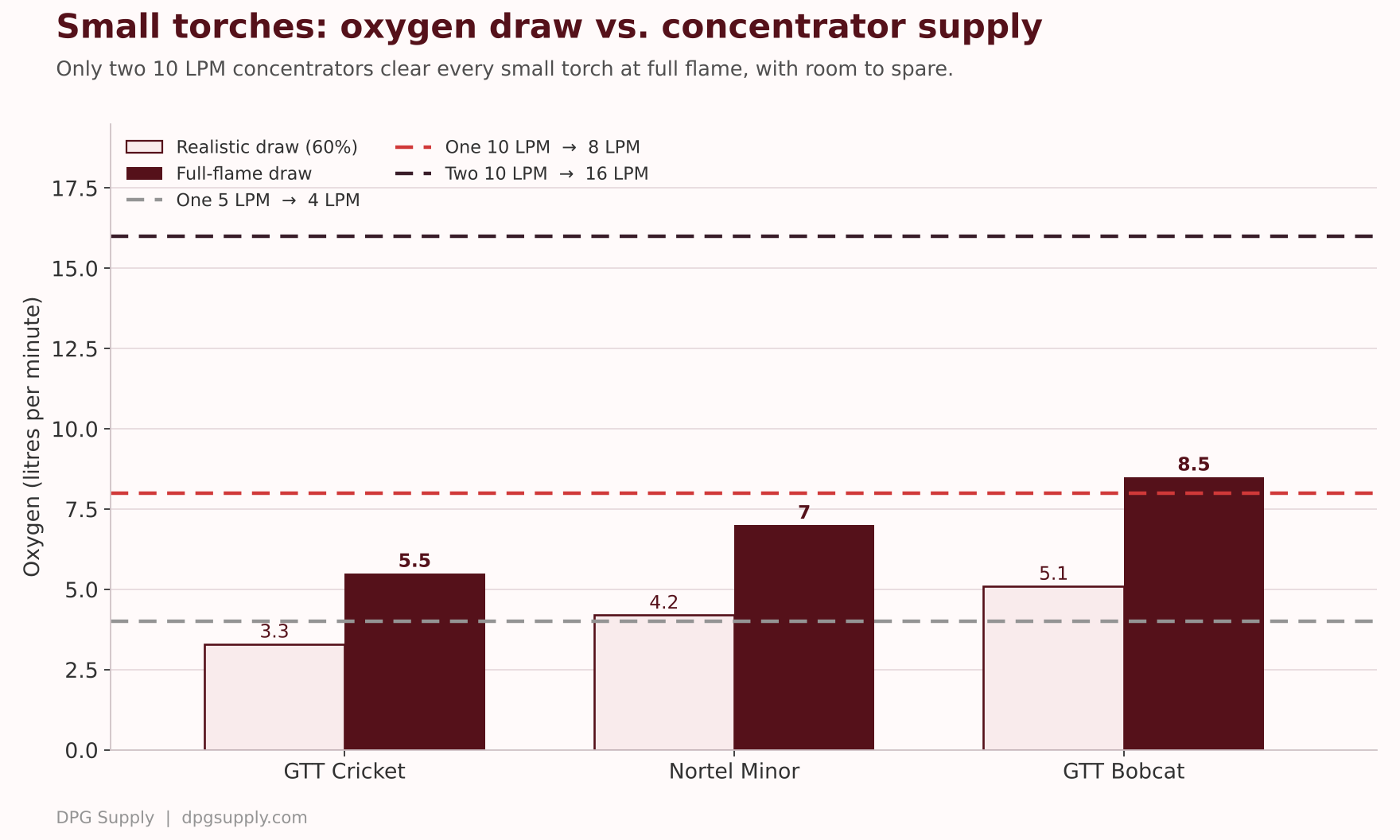
Oxygen draw for three common small torches, at full flame and at realistic settings, against what one 5 LPM, one 10 LPM and two 10 LPM concentrators actually deliver at 80% throughput. Only two concentrators clear every torch at full flame.
A lot of artists run these torches on a single 5 LPM concentrator. It works for light work, but turn the flame up and the concentrator can’t keep pace. One 10 LPM unit handles most of it. Two 10 LPM units cover all three torches at full flame with plenty of headroom.
Large torches: one concentrator vs. two, with a Stage 2
The Stage 2 stores concentrator oxygen in a tank so you can run a torch bigger than your concentrators could feed on their own. The tank drains at whatever the torch draws minus what the concentrators put back.
Running full out
| Torch | Max draw | One 10 LPM | Two 10 LPM |
|---|---|---|---|
| GTT Phantom | 16.5 LPM | about 2.5 hours | effectively all day |
| GTT Mirage | 26 LPM | about 75 minutes | about 2 hours 10 minutes |
| Nortel Red Max | 45 LPM | about 35 minutes | about 45 minutes |
Realistic use (60% average draw)
| Torch | Realistic draw | One 10 LPM | Two 10 LPM |
|---|---|---|---|
| GTT Phantom | 9.9 LPM | effectively all day | indefinitely |
| GTT Mirage | 15.6 LPM | about 3 hours | indefinitely |
| Nortel Red Max | 27 LPM | about 70 minutes | about 2 hours |
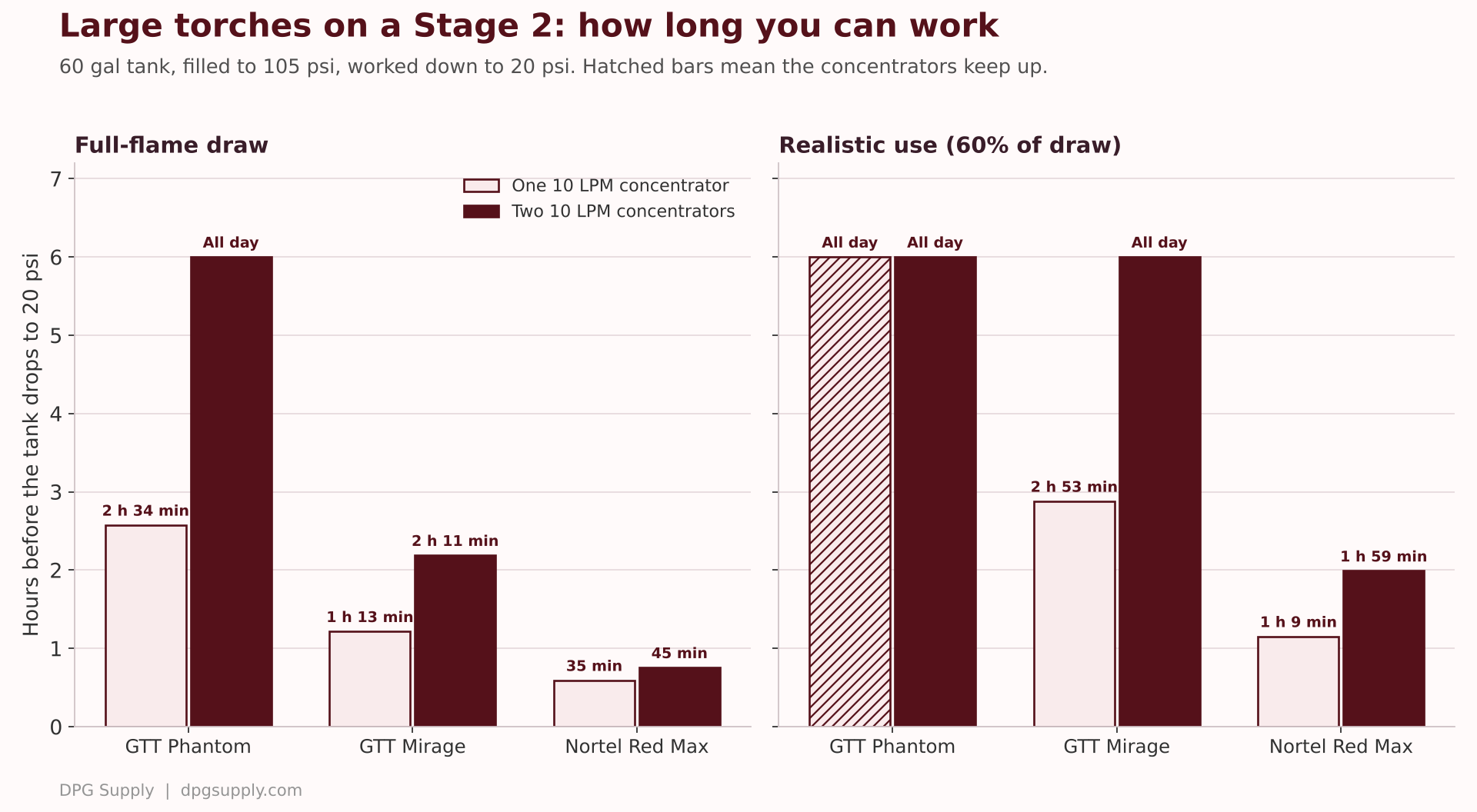
Hours of work on a 60 gallon tank, from 105 psi down to 20 psi, with one or two 10 LPM concentrators feeding a Stage 2. “All day” means the concentrators keep up with the torch, or nearly do.
Refill time
Once the tank is down to 20 psi, refilling it to 105 psi takes about 2 hours 45 minutes with one 10 LPM concentrator. With two, it takes about 1 hour 20 minutes.
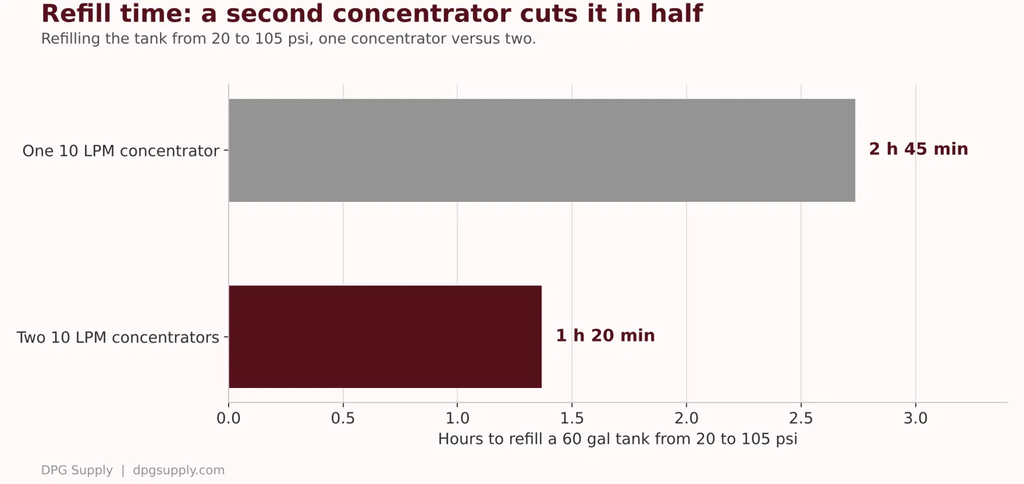
Time to refill a 60 gallon tank from 20 psi to 105 psi. Two concentrators cut the wait in half.
That’s the real story with one concentrator on a big torch. You can work for about an hour on a Red Max or a Mirage, but then you’re taking a long break. Two concentrators make the working stretch longer and cut the break in half. On a Mirage at realistic settings, the break goes away completely.
And yes, redundancy
Redundancy isn’t the main reason to run two concentrators, but it matters. If one goes down, you don’t lose the ability to blow glass. You go back to taking breaks while we repair the broken unit.
Bottom line
- No concentrator: you’re buying bottles.
- One concentrator: you’re off bottles, but limited. Expect breaks, especially on bigger torches.
- Two concentrators: double the capacity, nonstop work on small and medium torches, and much longer sessions on large ones with a Stage 2.
Run your own numbers in the Oxygen Runtime Calculator, or get in touch and we’ll help you size a system.
Two concentrators give you double the oxygen, half the refill time, and far fewer breaks. Even one concentrator beats buying bottles.
If you’re ready to make the switch, our Stage 1 Oxygen Concentrator 10 LPM is a brand-new, warranty-covered first stage for any oxygen system.
If you’re in the United States and want to buy used equipment instead, Bradshaw Oxygen sells pre-owned machines to American customers.
Leave a Reply